
Australia's opportunities and challenges in Nickel

08.02.2024 - 12:59
Our new report ‘A Critical Juncture’, commissioned by the Chamber of Minerals and Energy of Western Australia, explores Australia's opportunities and challenges in nickel. Our report finds we have inherent advantages as Australia is well placed to capture growing opportunities in nickel with a 9% annual growth forecast. Australia holds 18% of global reserves, which we can refine with significantly less emissions than our competitors. However, growing supply from cheaper Indonesian nickel producers that are more cost-competitive has led to lower prices, which has already seen the closure of a third of Australia’s nickel production. This puts approximately 10,000 jobs, $1.8 billion of economic activity, and Australia’s future battery industry at risk.
Australian nickel has significant opportunities, however strong headwinds are placing its future viability at risk.
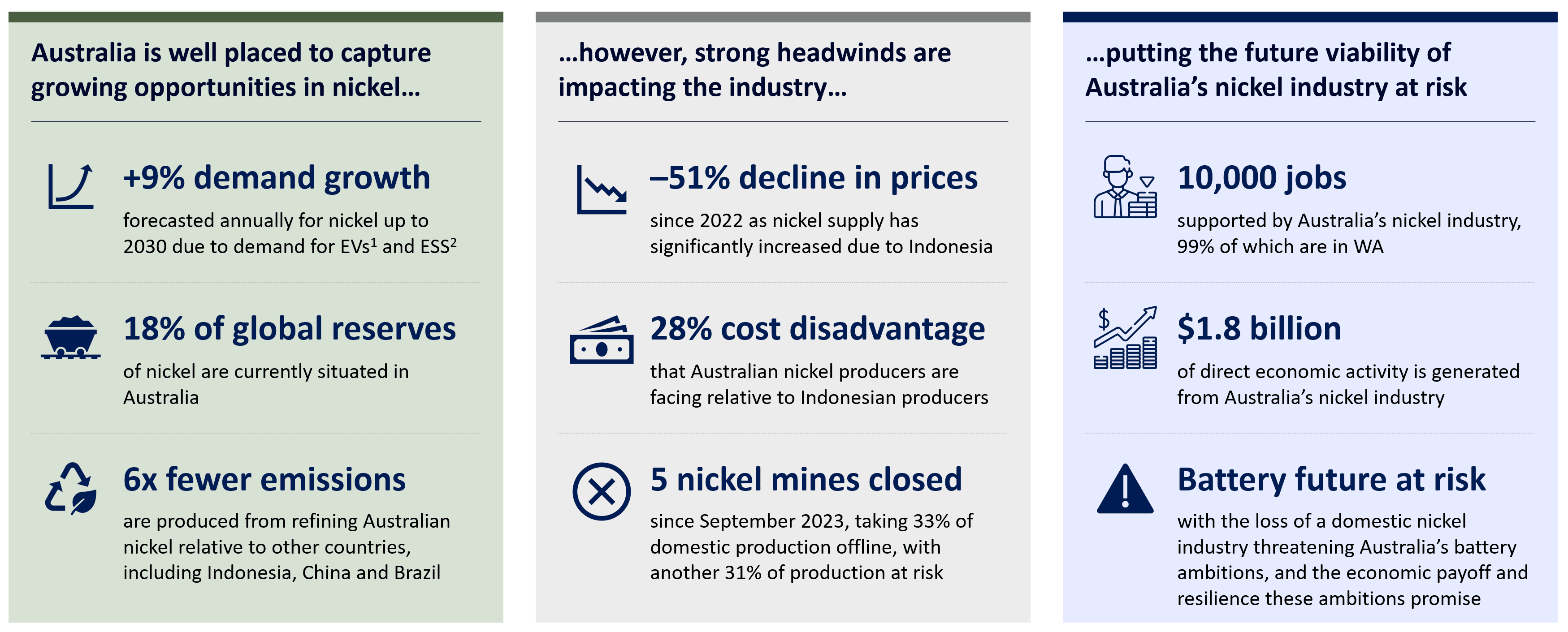
The energy transition offers significant opportunities for Western Australia’s resources industry and minerals exports such as nickel.
As the world accelerates efforts aimed at electrification and moves away from fossil fuels, Western Australia and Australia will need to capture growing opportunities in battery minerals, such as nickel, lithium, and cobalt. Battery demand is expected to increase by 24 per cent annually over the coming decade, driving the need for battery minerals.
Australia, and Western Australia in particular, is positioned to play an important role in the global battery value chain. Australia holds 18 per cent of global nickel reserves while also having (1) strong ESG practices and (2) global policy tailwinds.
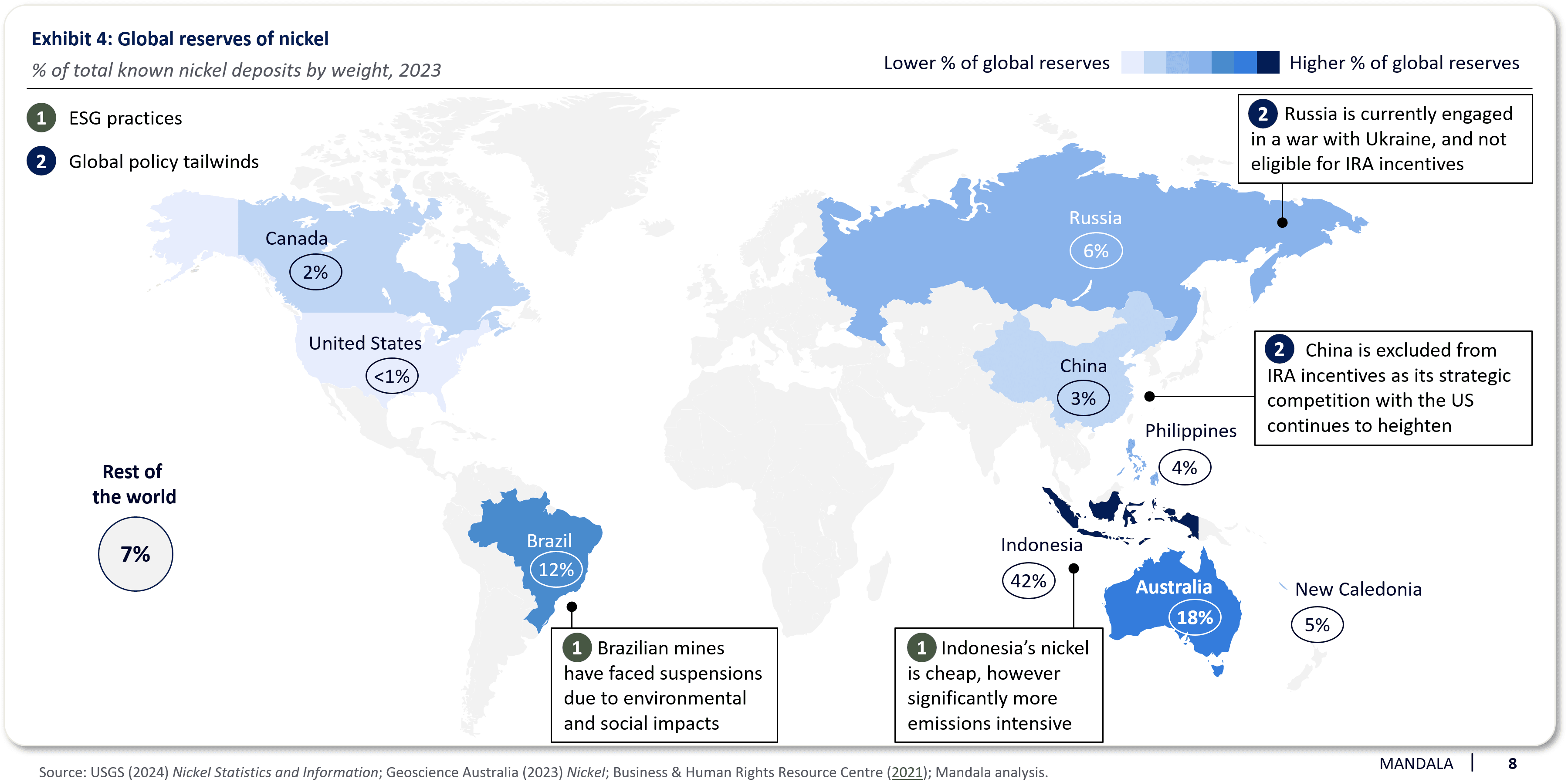
However, the Australian nickel industry is facing strong headwinds, and its future viability is at risk.
Recent drops in nickel price (down 51 per cent since 2022) and growing cost pressures in Australia have led to five Western Australian nickel producers, constituting a third of annual domestic production, announcing closures, with many other producers at risk.
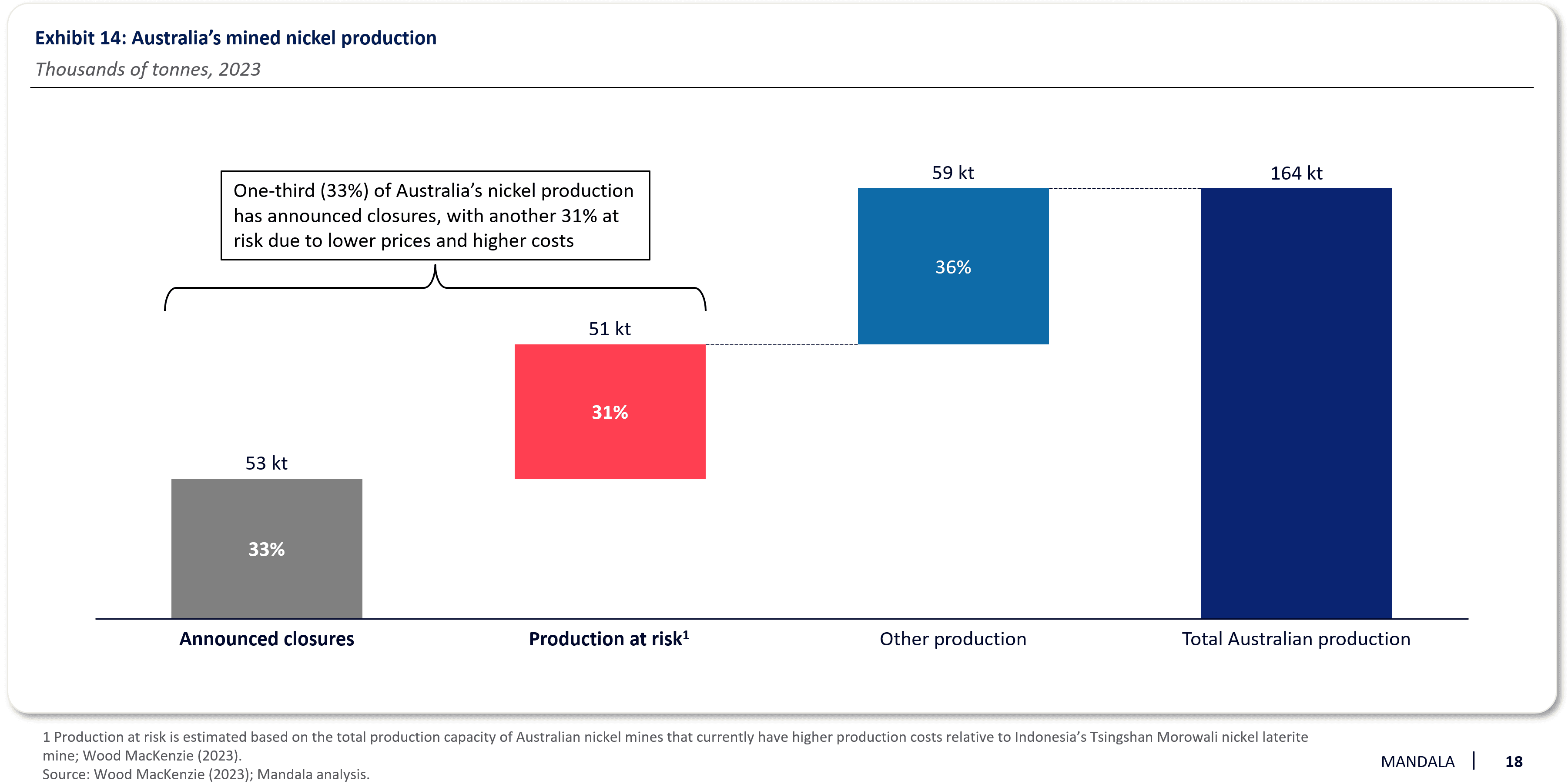
The nickel industry is strategically vital in supporting Australia’s sovereign capability, economic resilience, and resource security. The decline of the nickel industry puts at risk nearly 10,000 jobs, $1.8 billion of economic activity, and Australia’s future battery industry.
Download the full report here.
Read our latest posts

Rethinking the APR
Mandala's latest research, commissioned by Block, examines whether US credit disclosure requirements remain fit for purpose in a rapidly evolving lending market. Drawing on economic analysis, a survey of nearly 1,600 US consumers and small business decision-makers, and proprietary credit data, the report finds that Annual Percentage Rate (APR) disclosures can misrepresent the perceived cost of short-term borrowing and influence consumer choices. The report makes the case for modernising credit disclosure requirements, with a more flexible approach that better reflects different credit products while preserving consumer protection and access to credit.
15 Oct, 2026

The augmented attacker: the growing AI-driven cyber threat to Australian businesses
Mandala's latest research, commissioned by CyberCX (part of Accenture), shows that the AI-driven cyber threat to Australian businesses is growing. The report finds that AI could increase the frequency and severity of cyber incidents targeting Australian businesses. As AI-driven threats grow, Australian businesses could face losses reaching up to $37 billion a year. However, investing in foundational cyber defences such as patching known vulnerabilities could reduce annual losses from $37 billion to $13 billion, a $24 billion saving. Three-quarters of the savings are from preventative actions. The report highlights the actions required from businesses and government to improve cyber defence.
13 Oct, 2026

The Stagnant Nation: Lifting Australia’s Dynamism
Australians are going backwards on real wages and income. Real wage growth has fallen from 0.6 per cent in the 2000s to -0.7 per cent today, the slowest rate since the 1990s recession. Weak productivity growth is a key driver. Productivity growth has dropped from 2.2 per cent in the 1990s to just 0.1 per cent today. The Productivity Commission has pointed to declining economic dynamism as one cause for weak growth, with fewer businesses starting, growing and competing. We confirm declining economic dynamism across five key dimensions and estimate that reversing this decline seen since the mid-2000s could see a GDP uplift of $101 billion per year over the next decade. Our analysis finds that regulation could account for around 20 per cent of declining dynamism. Reducing regulatory burden to late-2000s levels could see GDP uplift of at least $20 billion per year over the next ten years.
7 Oct, 2026

Demonstrating the economic benefits of Airwallex in Australia
Mandala's latest research, commissioned by Airwallex, quantifies the direct and indirect economic benefits of Airwallex in Australia. Airwallex supported $4.6 billion in economic benefits in 2025, a figure roughly equivalent to 2 per cent of the Australian tech sector's contribution to GDP. Of this, $2.5 billion flows directly to platform businesses through productivity gains, new market access and cost savings, with the remainder reaching the broader economy as those benefits move through customers' supply chains. Airwallex supports 29,000 jobs across the Australian economy, and a quarter of economic benefits flow to regional, rural and remote areas. Small and medium businesses capture the largest share of any business segment on the platform, $2.1 billion annually, or $200,000 in economic benefits for the average SMB each year.
16 Sep, 2026